What does #1 New Release on Amazon mean? How to read the badge, with one book's dated example
What does #1 New Release on Amazon mean? It marks the lead among recent releases in one category at one moment. See how to read it and how it differs.
By Abdullah Mansoor · · Updated
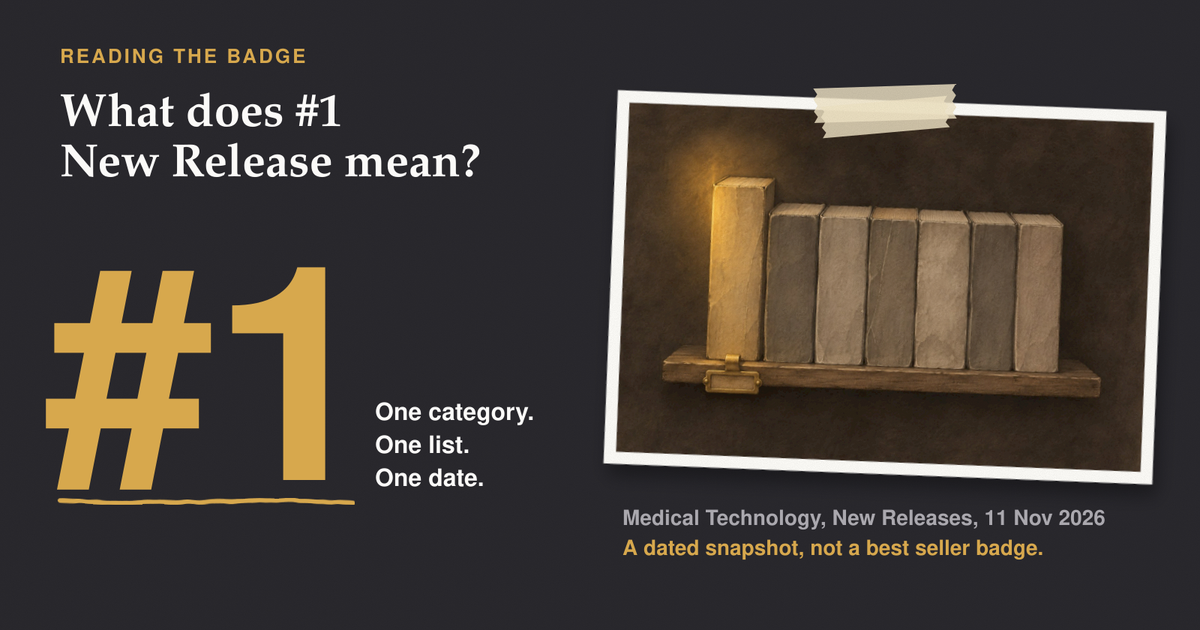
What does #1 New Release on Amazon mean? Amazon does not define the badge on the pages we checked, but the example below shows what it tracks: when the page was loaded, the book led the new releases list in one category. It is not a best seller badge, it does not say how many copies sold, and one author reports it can change hourly. Read it as a dated snapshot of one category's race, not as a verdict on the book.
What follows, in this article: how the New Releases and Best Sellers lists differ, why the badge comes and goes, one dated example, and what an author can honestly claim.
What does #1 New Release on Amazon mean next to Best Sellers?
Amazon runs separate lists. Its Hot New Releases pages describe themselves as "Our best-selling new and future releases." Its Best Sellers pages say "Our most popular products based on sales." Both add that they are "Updated frequently."
So a new release competes only against other recent titles. A book can lead that list without ranking high among all books. Amazon's pages we checked do not say how long a book counts as new. If your real goal is more readers over time, growing book sales on Amazon is a different job from chasing a list.
How does Amazon rank a book in a category?
Amazon's KDP help page on sales ranking gives the rule behind these lists. The page says rank is "based on customer activity" set against other books. It also warns that "Rankings are relative, so your Sales Rank can change even when your book's level of activity stays the same." Your rank can rise because other books went quiet.
The same page says that watching your rank "is not an accurate way to track your book's activity or compare its activity in relation to books in other categories." Amazon is telling authors that a rank is not a reliable measure of activity across categories. A badge is a rank with a label on it.
Why does the badge appear and disappear?
Amazon does not explain it, but its lists say they are "Updated frequently." Author Jorge Arango, whose book was launched in 2018, wrote that he saw "#1 New Release in Ethics" on his page, found it gone "a couple of days later", and then saw it again. His conclusion: the notice "seems to change hourly. (At least.)"
That is why a screenshot without a date proves little. The badge was true when the picture was taken and may not be true when you read about it.
What did the badge show for Lab Black Boxes?
Lab Black Boxes, a 331-page bench guide by Dr. Ibrahim Mansoor, was published on November 6, 2026. On November 11, 2026, its Amazon page showed the "#1 New Release in Medical Technology" badge on Amazon.com and was #1 on the Hot New Releases list for Medical Technology. The first-day figure was 10 copies. Amazon does not publish the copy counts behind these lists, so the badge alone tells a reader nothing about volume.
We use the badge as a dated fact and no more. It says the book led one category's new releases that day. It does not say how large the category is or how many copies the other books sold. The longer story of how the book was made is in how to publish a medical book.
How do you read any #1 New Release screenshot?
Ask four questions before you trust it, or before you post your own:
- Which category? "Medical Technology" is one subject category. "Books" is the whole store.
- Which list? New Releases and Best Sellers are different lists with different words.
- What date? If the capture has no date, you cannot tell whether it still holds.
- What is it measuring? Rank is activity relative to other books, not units sold. The product page also shows a Best Sellers Rank in the Product Details, and per KDP each format of a book has its own.
What can you claim if your book has the badge?
Write what the page showed and when. A line like "#1 New Release in Medical Technology on Amazon.com, November 11, 2026" is true and checkable. It gives an author bio or speaker page one line a reader can verify, the kind of plain proof that an author's personal brand rests on. Consultants who use a book to open conversations can read a book as a lead magnet. Calling yourself a top-selling author is not what the badge says.
Keep the capture, which takes a minute: open the category's list, take a screenshot with the date visible, and save it. A dated screenshot of the list is better than a memory, and it lets a reader see the category for themselves. Do not promise that the next book will repeat it. Nobody outside Amazon controls a relative rank.
Who should not chase the badge?
- You want proof of sales volume. The badge does not show it. Your own sales reports do.
- Your book serves a wide audience. A broad category is a bigger race, and a narrow one needs a narrow reader.
- You are tempted to buy copies for the rank. KDP's page says that if purchasing comes from accounts "attempting to manipulate our services," it "may result in termination of your account and loss of royalties."
- You are waiting on it to make a decision. Arango's notice came and went within days. A book stays on the shelf.
What should a doctor or expert do with this?
Amazon publishes no method for earning the badge, so none can be promised. What you control is a plain subtitle and categories that match your reader. Treat any badge that follows as a dated note, not the goal. The goal is a book your colleagues can use and your name can stand behind. Physicians who want help shaping one can see working with a writer as a doctor, with more on books and authority on the Inkly blog.
So what does #1 New Release on Amazon mean for you? Whatever the page shows next week, a badge is a good moment to list the questions readers keep asking you, because each one can become a chapter of your next book. Inkly Publishing is the publisher shown on the Amazon page for Lab Black Boxes. AI tools help with research and grammar; people do the interviews, writing, editing and judgment, and the author approves every chapter. If you want a plan for that next book, Inkly sends a free draft table of contents built from what you tell us; the request form sits on the physicians page, and any expert can use it. For the wider options, see nonfiction book publishing help. Ask for a draft table of contents for your next book.
Common questions
- Is #1 New Release the same as a best seller?
- No. Amazon describes its Hot New Releases lists as its best-selling new and future releases, and its Best Sellers lists as its most popular products based on sales. They are different lists, so a #1 New Release badge should not be described as a best seller.
- How long does a #1 New Release badge last?
- Amazon does not say on the pages we checked. One author, Jorge Arango, saw the notice on his book's page disappear and return within days, and wrote that it seemed to change hourly at least. Treat it as true only for the moment it was captured.
- How do I get a #1 New Release badge for my book?
- Amazon does not publish a method, and nobody outside Amazon can promise one. The KDP help page says category ranks are relative to the activity of other books. Our advice, not Amazon's: choose a precise category and write a clear subtitle before you publish.
- Can I call my book a top seller if it has the badge?
- No. The badge names a new-release list in one category. Write exactly what it shows, such as #1 New Release in Medical Technology on Amazon.com, with the date the page was checked.
Related articles
- How to publish a medical book: what one pathologist's first week on Amazon shows
How to publish a medical book while you still practise: interviews, chapters you approve, and a category choice, shown by one pathologist's Amazon launch.
- Nonfiction Book Publishing Help: Four Routes and Who Owns What
Compare the four ways to publish a nonfiction book, spot the warning signs of a bad publishing company, and get five questions to ask any service first.
- How Much Does It Cost to Hire a Ghostwriter for a Book? The Five Things That Set the Fee
The cost to hire a ghostwriter for a book depends on length, research, interviews, revisions and publishing. See what moves the fee and how to compare quotes.
- Book Ghostwriter for Business Owners: Time, Rights and Fit
Hiring a book ghostwriter for business owners? See what your time really goes to, which contract clause keeps the copyright yours, and who should skip it.