How to Get Speaking Gigs With a Book: A Plan for Nonfiction Experts
How to get speaking gigs with a book: turn chapters into three talk titles, list the rooms your readers sit in, and offer organisers copies instead of a fee.
By Abdullah Mansoor ·
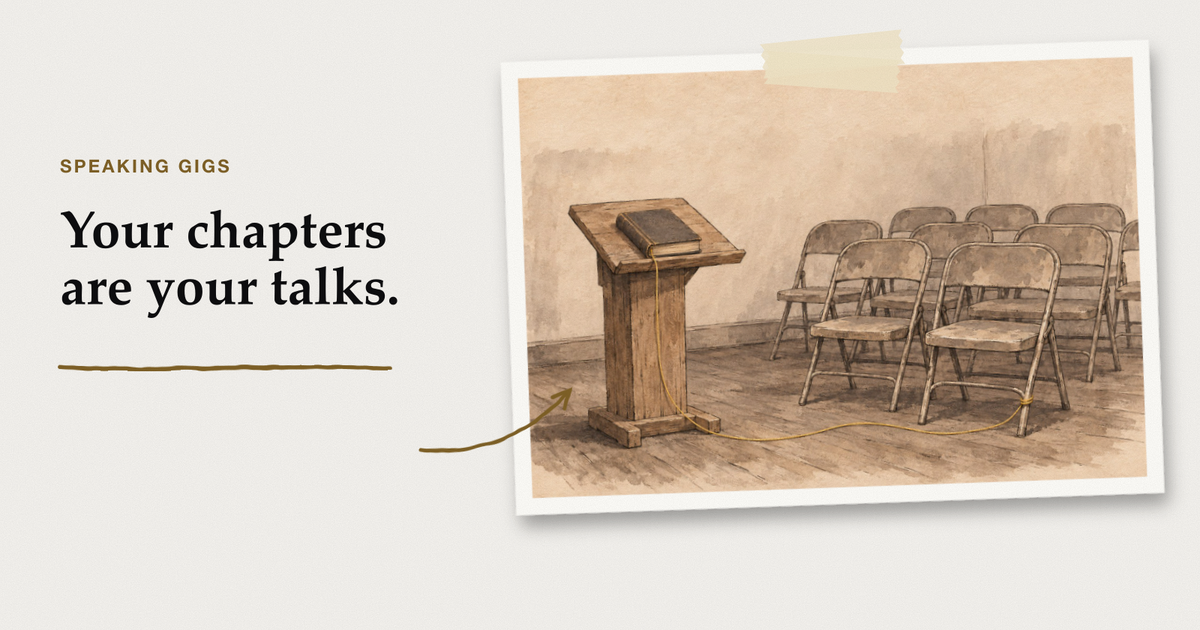
To get speaking gigs with a book, turn your chapters into two or three talk titles, list the groups whose members are your readers, and pitch the organisers who must fill a speaker slot every month. Start in small local rooms, record every talk, and let each audience lead you to the next one. Learning how to get speaking gigs with a book is mostly a matter of steady pitching, not fame.
In this article: why organisers pick authors, a five-step plan, what it costs you in time, and who should skip speaking for now.
Why is it easier to get speaking gigs with a book?
A book solves three problems for an event organiser. It tells them in one line what you know. It gives the host an easy introduction ("the author of..."). And it gives attendees something to take home, which makes the event look generous.
What a book does not do is send the invitations for you. Speaking slots go to people who ask, and to people someone recommends. Thomas Umstattd Jr. of Author Media puts it plainly: "Speaking gigs often come down to who you know."
That is good news for an expert. You already know clients, colleagues and members of professional groups. The book gives them a reason to put your name forward. If you are still deciding what your public profile should be built on, an author's personal brand starts from the same argument your talks will make.
Who books authors as speakers?
Most first invitations come from groups that need a speaker on a schedule, not from big conferences.
- Service clubs. Umstattd notes that "Rotary club presidents have to schedule a speaker every week."
- Professional associations. Monthly chapter meetings for accountants, engineers, HR leaders or clinicians need a topic each month.
- Companies and teams. A lunch-and-learn for staff whose problem your book addresses.
- Libraries, bookshops and universities. Good for practice, often smaller crowds.
- Online events and podcasts. Webinars count. So does a podcast episode the host can share.
The slots are often short. Writing as a guest on Jane Friedman's blog, author Dorit Sasson writes that at a local Rotary "You'll typically be given a twenty- to twenty-five-minute speaking slot." Plan your first talk for that length, not for an hour. No speaking experience yet? Sasson's point is that "You don't have to be a bestselling author or a member of the National Speaking Association" to get a local slot.
How to get speaking gigs with a book in five steps
-
Turn chapters into three talk titles. Pick the chapters that solve a problem a room would pay attention to. Give each a title in the audience's words, plus a two-line description. Umstattd advises including "titles and blurbs for at least three talks" so an organiser can choose the best fit.
-
Build a one-page speaker sheet. A headshot, a one-paragraph bio that names the book, your three talks and your contact details. Put the same page on your website, since organisers will search your name before they reply.
-
List the groups where your readers already meet. Write down every association, club, company team, conference and podcast whose members are the people your book is for. Aim for a long list, then work it a few pitches every week, for months, and follow up on each one.
-
Pitch the audience, not the book. Each pitch says what this group's members will leave with. A finance director's book pitched to a chamber of commerce becomes three cash-flow mistakes small firms make in their second year. Sasson describes pitching six different venues by changing the theme of her book for each audience.
-
Record every talk and ask for the next room. Umstattd writes: "I never book a speaker if I haven't heard a recording of them speaking." Record on your phone, keep the best few minutes, and at the end of each talk ask the host which other group should hear it.
What should you ask for when a group cannot pay?
Many early talks are unpaid. That is not a failure; it is how most authors build the recordings and references that later talks need. Umstattd says he "spoke for free long before I spoke at conferences for money."
There is a middle option worth offering. When the budget has no fee in it, ask whether the group can buy a copy of your book for each attendee. The organiser gets a gift for every seat. You get readers who have already heard you teach.
Sasson describes the smaller version of this: at a women's organisation she met through Toastmasters, she held a fundraiser for her book and "sold fifteen copies." Fifteen copies is not a business, but fifteen readers who met you is a room of people who can recommend you.
How long does it take, and what does it cost you?
Time is the real cost. A speaker sheet takes an afternoon. The pitching is the part that takes months: a few personalised emails a week, follow-ups, and travel time for in-person events. Early on, Umstattd set a goal "to speak six times each month," including very small rooms. You do not need that pace, but you need some fixed rhythm.
Expect the first bookings to be local and small. Bigger invitations usually come from someone who sat in a small room, which is why recording and asking for the next room matter more than the size of any single event.
There is a risk worth naming. A talk that only promotes the book feels like a sales pitch, and organisers do not invite those speakers back. Teach one useful thing from a chapter, and mention the book once at the end.
An illustration: one chapter, three rooms
Take an invented case, built only to show the method: a physiotherapist who has written a book on preventing back injuries in desk workers. Her chapter four covers the ten-minute daily routine her patients actually keep.
She turns it into three talks: The ten-minute routine that keeps desk teams off sick leave for HR associations, What your back is telling you at 3 pm for company lunch-and-learns, and Prescribing movement people will actually do for a clinicians' meeting. Each talk is 20 minutes, ends with one mention of the book, and asks the host for the next group. The HR talk is the one most likely to lead to bulk copies, because a company can give the book to every employee.
Who should not chase speaking gigs yet?
Speaking is not the right channel for everyone. Skip it for now if:
- Your book's readers do not gather anywhere you can name. Some audiences are better reached through Amazon and search than through rooms; see whether Amazon is worth it.
- You cannot teach a single useful lesson from the book in 20 minutes. Fix the talk first.
- Your book is not finished. Speak about your expertise, but pitch the book only once you have copies to hand out.
- You dislike speaking and would only do it under protest. Umstattd says it directly: "you can be a successful author without public speaking." A book used as a lead magnet or posts that sound like you can do the same job in writing.
What comes before the first invitation?
A book that a room can learn from. The talks above work because each one is a chapter in disguise: a clear problem, a method with a name, and an example the audience can picture. If your book is still an idea, building its chapters around the talks you want to give is a practical way to plan it. The same planning works for experts who publish medical books: write the talk list and the chapter list side by side. Still picking a route to print? A plain comparison of nonfiction book publishing help lays out each route in turn. If you already hold printed copies, the five steps above work as they stand; start with step 1 this week.
Mr Junaid, an author Inkly published, has sold 1,600+ copies. His workshop tour has more than 4,000 seats booked and has held events in Dubai, Riyadh, Medinah and Jeddah. If you want a book you can teach from a stage, and you are working out how to get speaking gigs with a book you have not written yet, the talk titles you want are the first draft of its chapter list. Tell us your field and the topic you'd teach. Our editors prepare a free draft table of contents for your book and email it to you within a few days. You keep it whether or not we ever work together. We built the request form for physicians, but a speaker in any field can send it: request your free draft table of contents.
Common questions
- How do I get my first speaking gig as an author?
- Start with groups that need a speaker on a schedule, such as Rotary clubs, professional associations and local business lunches. Send the organiser a one-page sheet with three talk titles taken from your chapters, and ask a friend who belongs to the group to introduce you.
- Do event organisers care if I have a book?
- A book makes you easier to describe and easier to introduce, and it gives the organiser something to hand attendees. It does not replace a good talk. Organisers still want to hear a recording of you speaking before they book you.
- How much do authors get paid for speaking?
- Early talks are often unpaid. What changes the fee is your field, the audience size, your recordings and the demand for your topic. When a group cannot pay, offer that the group buys a copy for each attendee.
- How long does it take to get speaking gigs with a book?
- Expect months, not weeks. Small rooms come first, and invitations to larger events usually come from people who heard you in a small one. A steady rhythm of pitches matters more than one big push.
Related articles
- Personal Brand for Authors: Meaning, Examples and a Weekly Plan
What a personal brand for authors actually is, three real examples, who it does not suit, and a one-hour weekly plan built from your own book chapters.
- Book as Lead Magnet for Consultants: Turn Readers Into Client Conversations
A book as lead magnet for consultants works when readers get a next step: a bonus they sign up for, a workshop on your method, and one clear way to reach you.
- How to Increase Book Sales on Amazon After Launch
How to increase book sales on Amazon after launch week: fix your categories, keywords and description, ask the right readers for reviews, and test small ads.
- How a Book Builds Authority for Consultants, and Where It Stops
How a book builds authority for consultants: it gives prospects a full sample of your thinking before the first call. See the survey figures and the limits.