LinkedIn posts that don't sound like AI: six tells to cut and how to keep your own voice
LinkedIn posts that don't sound like AI: six tells readers notice, why detectors and readers both get it wrong, and a short method to keep your own voice.
By Abdullah Mansoor · · Updated
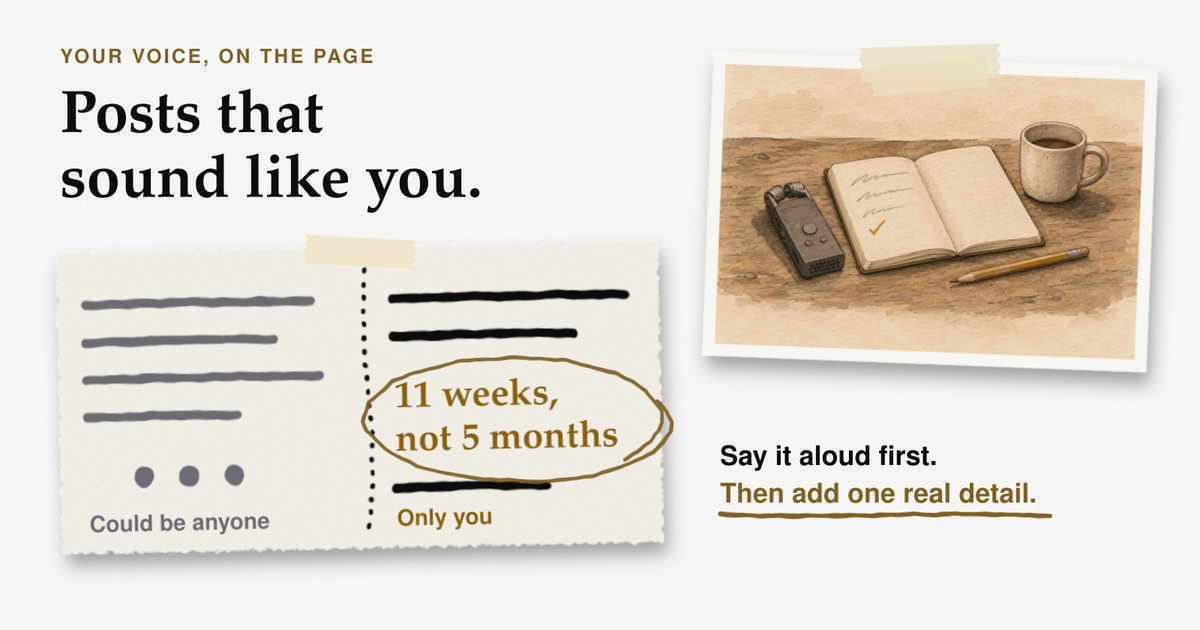
LinkedIn posts that don't sound like AI hold something only you could know and drop the stock shapes that make every post sound alike. The tells are usually small: a list of three, a closing line that summarises what you just said, a vague many leaders find. Swap them for one dated, checkable detail from your week and the post has something a reader can check.
In this article:
- Six habits readers flag, and why neither people nor detectors can tell for certain.
- A five step method to keep your own voice, with a worked before and after.
How do you write LinkedIn posts that don't sound like AI? Start with the six tells
Six habits tend to give it away, and they are the ones readers point to when they call a post "AI slop". This list is our editorial judgment, not research, so test it against your own drafts:
- Three of everything. Clarity, consistency and confidence. Wikipedia's editors say LLMs overuse the rule of three. Two items, or one, reads as someone who counted.
- The not just X, but Y turn. It sounds like insight and says little. State Y.
- A summary line that repeats the post. In short, authenticity matters. The reader already read it.
- Praise words with no object. A powerful reminder or a game-changing approach. Name the thing that was powerful.
- No countable detail. No day, figure, tool, name or place. A post you could attach to any company is a post nobody remembers.
- Stiff phrasing. Lines you would never say across a table to a client.
None of these proves a machine wrote the post. People wrote this way long before chatbots did, and a post with all six can still be honest. The point is that readers now read the six as a signal, and the signal costs you attention. The same habits explain much of why the whole feed can feel fake.
Can readers or detectors tell for certain?
No, and the evidence is worth knowing before you spend an evening trying to beat a detector.
On the human side, Wikipedia's guide to spotting machine-written text is blunt: "Humans are notoriously bad at distinguishing human and LLM-generated text." It cites a 2025 study finding that people's ability to tell the two apart is no better than random chance, and also notes a 2025 preprint in which a subset of "expert" annotators correctly identified 90% of AI-generated text. The same page notes that human speech and writing is being influenced by language models and becoming more similar, so your honest style may drift toward theirs without you noticing.
On the software side, a 2023 study tested seven widely used detectors on 91 essays written by non-native English speakers for the TOEFL exam. The detectors flagged 61.22% of them as AI-generated on average, and 89 of the 91 essays (97.80%) were flagged by at least one detector. The authors say the detectors "consistently misclassify non-native English writing samples as AI-generated".
That study is from 2023 and tested the tools of the time, so newer detectors may do better, but Wikipedia's editors still advise: "Do not solely rely on artificial intelligence content detection tools" because they have "non-trivial error rates".
Two things follow. First, a detector score is not a verdict on your post. Second, detectors can mislabel honest human writing, as that study found for non-native writers, so do not judge a post by a score. Aim at the thing a reader can check for themselves: whether the post says something specific.
How do you keep your own voice in a post?
Start from what you said, not from a blank page. Five steps, a short sitting for one post:
- Talk it first. Say the point out loud to a colleague, or record it on your phone. Write down the sentences that came out of your mouth, including the odd ones.
- Keep two of your own phrases. Words you use at work, even a slightly blunt one. A post with at least one phrase you would defend in a meeting sounds like you.
- Add one fact a stranger could not guess. A date, a number, a named tool or a place. If you cannot publish it, say less, not something vaguer.
- Cut the stock shapes. Check the list above. Delete the summary line first.
- Test it on a stranger's question. Ask what a reader could repeat to a colleague tomorrow. If nothing in the post survives, go back to step 3.
If a chatbot gave you the first draft, the same five steps apply: replace each general claim with a detail from your week.
Below is a pair of posts, both invented for this page as an illustration, from an adviser whose draft reads like a template. Neither comes from a client.
Before: Cash flow is not just a number, but a mindset. By focusing on clarity, consistency and control, businesses can thrive. A powerful reminder for every founder.
After: On Monday I told a client that her runway was 11 weeks, not the 5 months her spreadsheet showed. Two invoices had been counted twice. She was annoyed for about a minute, then asked me to check the other three clients' sheets. I do that first now, before any forecast.
The second version gives a weekday, two figures and a changed habit, with no moral and no triple. Someone who does similar work can use it, which is the reason to post it. Doctors who want more pairs like this can read these example posts written for doctors.
Run the five steps on the first post. Said aloud, the adviser's own sentence is I found two invoices counted twice. Step 3 adds Monday, 11 weeks and 5 months. Step 4 deletes the summary line. Step 5 asks what a reader could repeat, so the corporate wording becomes I do that first now, which a client could pass on.
Does it matter if you use an AI tool along the way?
That is your call, and it depends on your field's rules and your own comfort. The test does not change: could you have said this line yourself, and can you stand behind every fact in it? LinkedIn's community policies for professionals tell members to keep what they share "real and authentic". The policy does not mention AI writing tools, so it is about whether what you post is true, not about how you drafted it. A claim you cannot defend fails that test, however it was produced.
The risk is practical as well as ethical. A post you cannot explain to a client who asks about it in a meeting can cost more trust than a plain post would. If a post is going out under your name, you need the facts to be yours.
What does it look like when a team keeps your voice for you?
When the ideas are yours and the hours are not, someone else can do the drafting from your own words. That only works if they have heard you. If you are new to the idea, read what LinkedIn ghostwriting means in practice and the fuller guide on handing your posts to a writer as an expert.
Inkly turns short interviews with an expert into LinkedIn posts and long-form articles in their voice; the expert approves every piece before it is posted. Each interview is recorded and runs 20 to 25 minutes. AI tools help with research and grammar; people do the interviews, writing, editing and judgment.
Picture a physiotherapist (an illustration, not a client) who spends 20 minutes talking about why she stopped giving every patient the same stretching sheet. The interviewer's follow-up is Which patient changed your mind? and she says it was a runner whose knee pain eased once she shortened his stride. That answer, kept in her words and with the patient left out, is the post. She swaps one word that is not hers and signs off.
For the wider picture, see why LinkedIn can feel fake, which parts of posting a founder can delegate, how consultants share the drafting and LinkedIn content for doctors.
Which readers should skip this method?
- You want a setting that makes software sound like you. This page tells you to start from your own words, which takes more of your time.
- You post for a regulated employer. Follow your employer's policy first; it sets what you may say publicly.
- Nothing real has happened worth posting yet. A post written only to keep a streak tends to read as the six tells above.
- You need quick results. There is no set time for posts in your own voice to pay off, and this page does not promise one. The aim is modest: a client or colleague reads it and sees something about your work they could not have guessed.
- You will not read the final draft. Whoever writes it, you answer for every line.
What does your headline say that your best post does not?
Some of the six habits can show up in a profile too, where a reader may see your headline before a post. Count how many your headline and first About lines contain.
Put your headline next to your best recent post. If the post names a real decision and the headline is only job nouns, the headline is the part that reads like a template. Authors can take the same check further with a personal brand built around a book. Getting LinkedIn posts that don't sound like AI is easier once the profile above them matches. If you would like an outside read, email hello@inklyai.io with your profile link, and a few days later you get written notes on your headline, your About text and the items you feature. Request the free LinkedIn profile review.
Common questions
- How to write LinkedIn posts that don't sound like AI?
- Put in what only you could know: a date, a number, a name you may publish, a decision you made. Then cut the stock shapes, such as three-item lists, a closing summary line and a question that asks for nothing. Then ask what a reader could repeat to a colleague tomorrow, and change any line that gives them nothing.
- Can anyone tell if a LinkedIn post was written by AI?
- Not reliably, and in a 2025 study people did no better than chance. Wikipedia's guide to spotting AI writing says humans are notoriously bad at telling human and machine text apart, and a 2023 study found seven detectors flagged 61.22% of TOEFL essays by non-native English writers as AI-generated on average. Treat any single verdict as a guess.
- Should I run my posts through an AI detector?
- It will not tell you much. Wikipedia's editors say detectors perform better than random chance but have "non-trivial error rates", and the 2023 study found they flagged most essays by non-native English writers. Treat a score as a hint. A better check is whether the post holds a detail a stranger could not have invented. If it does, the score matters less.
- Is it a problem if I use an AI tool to help with a post?
- LinkedIn's community policies for professionals tell members to keep what they share "real and authentic" and do not mention AI writing tools, so the test is whether you stand behind every claim and could say every line yourself. Whatever helps you get there, your name sits under the post and the facts in it must be true.
- How to get professional help with LinkedIn posts in your own voice?
- Inkly turns short interviews with an expert into LinkedIn posts and long-form articles in their voice; the expert approves every piece before it is posted. Scope and price are discussed on a call.
Related articles
- Why does LinkedIn feel fake? Five patterns readers spot, and how to post like yourself
Why does LinkedIn feel fake? Five post patterns that read as hollow, what AI-detector data says about the feed, and how to write posts that sound like you.
- LinkedIn ghostwriting for founders: what to hand over and what to keep
LinkedIn ghostwriting for founders: what a writer can take over, what must stay yours, the account rules to follow, and how a short recorded interview fits in.
- LinkedIn content for doctors: what to post, what to leave out, and where the time comes from
LinkedIn content for doctors, step by step: what to post, the AMA's privacy and honesty rules, how to sound like a colleague, and how to find the time.
- What is LinkedIn ghostwriting? How it works, what it asks of you, and when it helps
What is LinkedIn ghostwriting? A writer drafts posts you publish as yourself. See the steps, LinkedIn's account rules, your time, and who should skip it.