LinkedIn content for doctors examples: six posts to adapt, and the rules behind them
LinkedIn content for doctors examples: six sample posts with no patient details, the AMA and LinkedIn rules they follow, and how to adapt each one.
By Abdullah Mansoor · · Updated
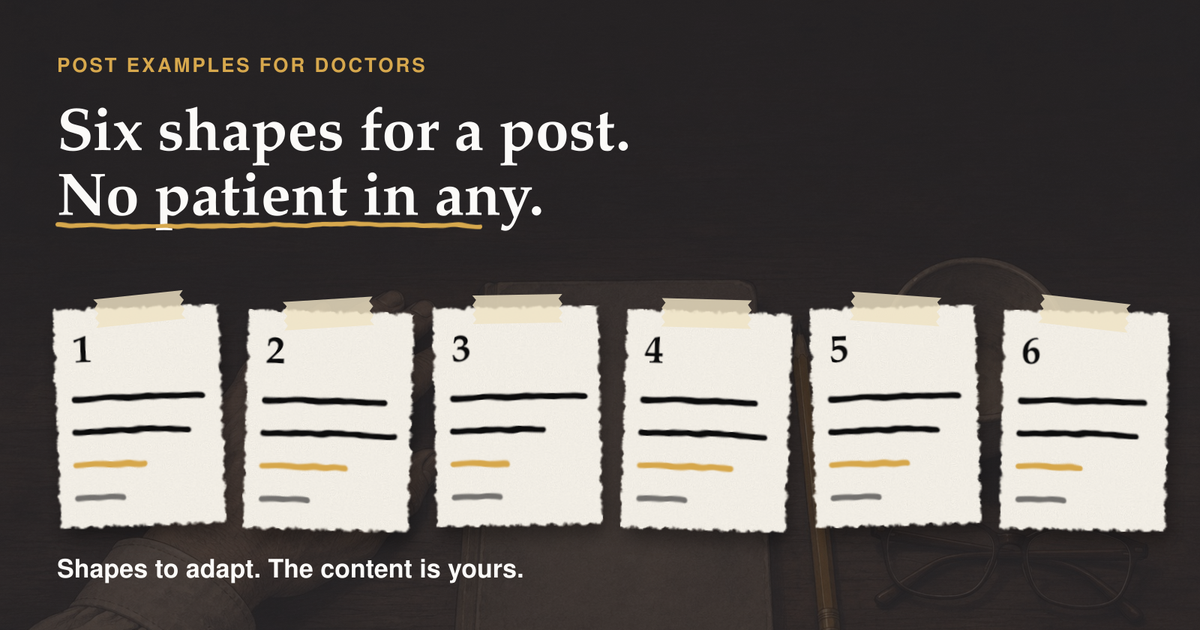
These LinkedIn content for doctors examples are six short posts you can adapt. Each is one piece of judgment with no patient in it, and each shows a different shape: a changed habit, a trainee lesson, a myth, a question, a method mistake, a reflection. The AMA and LinkedIn rules they stay inside come after the examples. All six are our own illustrations, written for this page, and none comes from a client.
In this article:
- Six example posts, each a different shape, with no patient in any of them.
- The AMA and LinkedIn lines they stay inside, and how to make a shape your own.
What do good LinkedIn content examples for doctors look like?
Good LinkedIn posts by doctors are short, stay on one idea and carry no patient detail. Each example below is under 45 words. Change the nouns and keep the structure.
Habits and lessons
- The changed habit. I used to finish my notes at home. Now I block fifteen minutes before I leave the ward, and the notes are shorter because I write them while I still remember the reason for each line. What did you stop doing at home?
- The trainee lesson. The first thing I tell a new trainee: write down what you were unsure about, not only what you did. Doubt that is on paper gets reviewed. Doubt that stays in your head gets repeated. What would you add?
Myths and questions
- The myth about the job. People think the hard part of clinic is the difficult case. For me it is the last ten minutes: deciding the one thing I want understood before the appointment ends. Do you plan that part, or does it happen to you?
- The question. Honest question for colleagues: what is the one sentence you wish every referral letter contained? I will collect the answers and share them back.
Method and reflection
- The mistake in method. I have learned to distrust my first impression on a busy day. Now I wait one extra minute before I commit to a plan. It rarely changes the plan. It often changes what I check first.
- The reflection. Teaching on a night shift taught me more about explaining than any course. Tired juniors ask the plain questions. I try to answer them as plainly as they ask.
No example names a patient, a hospital or a diagnosis, and none tells a reader what treatment to take. The next section shows why, and our guide on why LinkedIn feels fake explains what readers distrust.
Which rules do these examples stay inside?
The AMA's ethics opinion on social media (Opinion 2.3.2) applies in the US; check what your own regulator and employer require. Three of its lines shape the examples above:
- Because personal and professional personas blur online, physicians and medical students should "curate their social media presence accordingly."
- When publishing, they should "consider that even personal social media posts have the potential to damage their professional reputation."
- Physicians should "be aware that once on the Internet, content is likely there permanently."
The third line is why none of the examples runs on a case, even a disguised one. A post you cannot take back deserves a stricter test than a conversation in a corridor.
LinkedIn adds its own rule. Its Professional Community Policies say "Do not share content that directly contradicts guidance from leading global health organizations and public health authorities; including false information about the safety or efficacy of vaccines or medical treatments." Examples 1 to 6 describe how a doctor works and thinks, so they stay clear of that line. A post that tells readers what medicine to take is another matter, and it needs a source and a check against your regulator's rules before it goes up. Nothing here is legal or regulatory advice.
How do you adapt an example without sounding like a template?
Three small moves turn a shape into your post.
Swap in one real detail. Example 1 says fifteen minutes. Your number might be five or forty. A true number is the cheapest way to sound like yourself; more on that in keeping a post in the voice you speak with.
Cut the line you would not say aloud. If a sentence needs a breath in the wrong place, you wrote it for the page and not for a colleague. Remove it.
Keep the closing question only if you want the answers. Examples 1 to 4 end on a question. If you will not read the replies, end on the statement.
A short worked case, invented for this page: a physician reads example 2 and recognises her own habit: she keeps a small notebook of the things she was unsure of that week. She does not copy the post. She writes one line, in her own order, that starts with the notebook. Her line is more hers than any of the six above, because it begins with an object only she owns.
Does posting like this do anything for a doctor?
It does something slow. On its 95-5 rule page, LinkedIn's B2B Institute puts the share of potential buyers who are "out-market" today at 95%, and says they will be buyers later. That is B2B advertising research about companies, not doctors, so treat it as an analogy: the people who may one day refer, hire or invite you are mostly not looking today, and a steady record of how you think is there when they start.
No post promises a referral, a speaking invitation or a number of followers. Judge six weeks of posts by something smaller: did a colleague mention one?
Who should not post these examples?
- You can only make the point with a case. If the idea vanishes when the patient goes, it is not a LinkedIn post yet.
- Your employer limits public posting. Ask what is allowed in your own name before the first draft.
- You want to copy the six examples as they stand. They are shapes, not content, and a stranger's habit under your name reads as one.
- You expect patients to arrive from a post. Your regulator may limit what you say to attract them.
What if you have the ideas but not the hours?
Two routes work. Write the posts yourself in one weekly block, or let someone draft them from a conversation with you, the everyday form of LinkedIn ghostwriting. In both, you approve the final text before it is posted. The wider method for busy specialists is in LinkedIn ghostwriting for experts.
Inkly turns short interviews with an expert into LinkedIn posts and long-form articles in their voice; the expert approves every piece before it is posted. Every interview is recorded, and each one runs 20 to 25 minutes. AI tools help with research and grammar; people do the interviews, writing, editing and judgment, and the author approves every chapter. Physicians are among the people we work with today.
For a doctor, that could mean one recorded conversation about a habit like the fifteen minutes in example 1, with the post built from your answers and returned for your approval. Leave patients out of the interview as well. The same short interviews can also become a book: see a book from the same interviews and publishing a medical book while you practise, and for the full picture of the topic read LinkedIn content for doctors.
Where will readers go after one of these posts?
Each of these six posts ends in the same place: your name, and then your headline. Open your own profile and ask one thing: could a stranger tell, from the top of the page, what you write about? If not, the post is doing work the headline has not caught up with.
Good LinkedIn content for doctors, like the examples above, works best when the profile matches it. For an outside reader on the top of your page, email us the address of your profile, with nothing about a patient. Within a few days you get written suggestions on your headline, About text and featured items. Request the free LinkedIn profile review.
Common questions
- What are good examples of LinkedIn posts for doctors?
- Posts about how you think, not about who you treated: a decision you changed, a habit you teach trainees, a question you ask colleagues. Six written examples are above, each marked as our own illustration. Adapt the shape and replace the content with your own.
- Can a doctor use examples of LinkedIn posts without patient stories?
- Yes. No example here is built on a patient, a diagnosis or a case. The AMA's ethics opinion on social media tells physicians to refrain from publishing patient information online without appropriate consent, so the simplest route is to leave patients out.
- How to use an example post without copying it word for word?
- No. A copied post is not yours, and LinkedIn's Professional Community Policies ask members to "share information that is real and authentic". Keep the shape, then fill it with something you have actually done or said.
- What is the best way for a doctor to handle health advice on LinkedIn?
- Be careful. LinkedIn's Professional Community Policies say not to share content that directly contradicts guidance from leading global health organizations and public health authorities. Posts about your reasoning and habits carry less of that risk than posts that tell readers what to take or do.
- Does Inkly write LinkedIn posts for doctors?
- Inkly turns short interviews with an expert into LinkedIn posts and long-form articles in their voice; the expert approves every piece before it is posted. Physicians are among the people we work with today.
Related articles
- LinkedIn content for doctors: what to post, what to leave out, and where the time comes from
LinkedIn content for doctors, step by step: what to post, the AMA's privacy and honesty rules, how to sound like a colleague, and how to find the time.
- Ghostwriter for doctors: how to get your book written in short weekly interviews
Thinking of hiring a ghostwriter for doctors? What one does, the questions physicians ask first, how long a book takes, and what it asks of a busy doctor.
- What is LinkedIn ghostwriting? How it works, what it asks of you, and when it helps
What is LinkedIn ghostwriting? A writer drafts posts you publish as yourself. See the steps, LinkedIn's account rules, your time, and who should skip it.
- Why does LinkedIn feel fake? Five patterns readers spot, and how to post like yourself
Why does LinkedIn feel fake? Five post patterns that read as hollow, what AI-detector data says about the feed, and how to write posts that sound like you.