Why does LinkedIn feel fake? Five patterns readers spot, and how to post like yourself
Why does LinkedIn feel fake? Five post patterns that read as hollow, what AI-detector data says about the feed, and how to write posts that sound like you.
By Abdullah Mansoor · · Updated
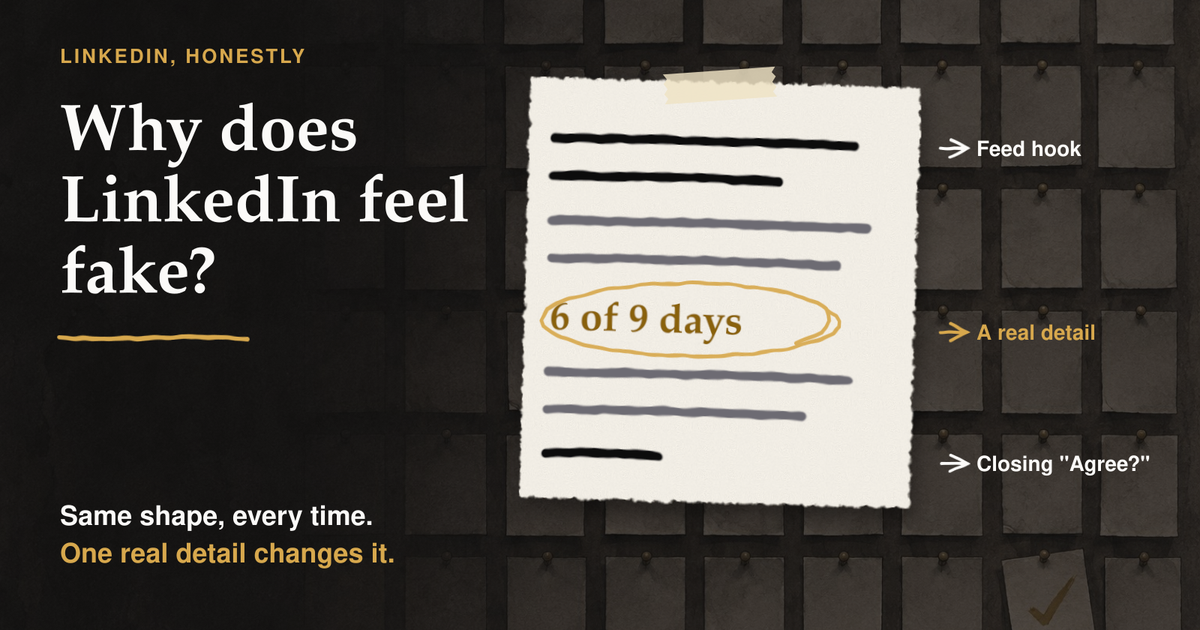
When readers ask why does LinkedIn feel fake, they are usually reacting to one thing: a post built to perform rather than to report. A story with a tidy moral, a first line written for the feed and a voice that belongs to nobody in particular all tell the reader that the writer was not really in the room. What helps: post a short report from your actual week, include one detail a reader could check, and drop the borrowed shape.
In this article:
- The five post patterns readers spot, and what the detector data does and does not show.
- A before and after example, plus a five step fix you can run this week.
Why does LinkedIn feel fake, and which post patterns cause it?
Five patterns do most of the damage. They are our own editorial judgment, not research findings, so test them against your own feed.
- The tidy moral. A struggle, a turning point and a lesson, in the same order, week after week. Real work seldom hands you a lesson by Friday.
- The hook written for the feed. A first line that promises a secret and delivers a platitude. Readers learn to skip the promise.
- No countable detail. A client once told me and we grew fast give the reader nothing to hold. A day, a number or a named thing does.
- A voice nobody speaks in. Sentences you would never say to a colleague across a table, such as I am humbled to announce.
- The closing question that asks for nothing real. "Agree?" at the bottom of a post that has not said anything to agree with.
None of these is wrong on its own. A moral can be true. The problem is a feed full of the same five moves, because a reader who has seen the shape forty times stops reading the content inside it. For more on the voice problem in particular, see writing posts in a voice that is plainly yours.
Is the feed getting more fake, or does it only feel that way?
Part of it is measurable, with limits. Originality.ai, a company that sells AI-detection software, has tracked long-form LinkedIn posts for some time. In its July 2026 update, it analysed 5,000 public posts of at least 100 words across nine topics, and says it chose the final 5,000 before checking any AI scores. It reports that 4,061 of them, 81.2%, were classified as "Likely AI", up from "roughly half" in its late 2024 study. The same page says LinkedIn is rolling out a "Seems like AI slop" option in the three-dot menu of a post.
Read those figures with care:
- The detector is one vendor's tool, and its label is an estimate, not proof of who wrote a post.
- The sample covers public posts found through the company's own searches, "not every LinkedIn post or anyone's personal feed".
- A flagged post can still hold someone's real view. What readers react to is sameness, and sameness is something you can see without a detector.
LinkedIn's own rules point the same way. Its Professional Community Policies include "Be trustworthy" among three headline rules and tell members to use a "true identity" and share content that is "real and authentic". That does not mean raw or unedited. It means a post should say something that happened or something you think.
What does a post that reads as real look like?
Here is a before and after. We wrote both for this page as illustrations, and neither is a client's post.
Before: "Last week a client taught me a powerful lesson about trust. Here is what I learned. Agree?"
After: "A client asked on Tuesday why our report took nine days. The honest answer is that six of them were spent waiting for her team's data. We now send a two-line data checklist before the kickoff call."
The second version has a day, two numbers and a change someone made. It has no moral at the end, because the checklist is the point. Doctors can find the same idea worked through in these LinkedIn post examples for doctors. A reader in the same line of work can use it, and can tell it came from someone who did the work.
Report what happened, say what changed, and stop. If you are weighing whether posting is worth the effort, the aim is modest: when a client or colleague reads a post about work you did, they see something they would not otherwise see.
How can you fix your own posts this week?
You need one real event and a few minutes of honesty:
- Pick one thing that happened in your work this week. A call, a mistake, a decision, a question a client asked.
- Write it in the order it happened, in the words you would use to tell a colleague.
- Add one number, date or name you are happy to see in print.
- Cut the moral. If the point is not already visible, add a second event, not a lesson.
- Read it aloud. Change any line you would not say.
Three posts a month written this way is a pace you can test against your own calendar. Do not expect a date for results: we cannot tell you how many followers or enquiries will follow.
Can someone else write your posts and keep them real?
Yes, if the writer has heard you. Posts built from a theme list sound fake because the writer has never watched you argue with a client. Posts drawn from what you said aloud can keep your examples and your wording. If the idea of a hired writer is new, start with a plain explainer on LinkedIn ghostwriting, then the longer guide for experts who hand over their posts.
Inkly turns short interviews with an expert into LinkedIn posts and long-form articles in their voice; the expert approves every piece before it is posted. Every interview is recorded and runs 20 to 25 minutes. AI tools help with research and grammar; people do the interviews, writing, editing and judgment, and the author approves every chapter. The ideas and the final yes stay with the expert, because Inkly is not a ghostwriter.
For one more example, picture a consultant (an illustration, not a client). She is recorded for one interview, where one question might be what a client got wrong this month. The answer is the data-checklist story above, in her own words, plus a detail she says out loud: the client's team had no single owner for the data. The draft comes back with both. She cuts one line that sounded like a brochure and signs off on everything else.
For the fuller picture of the topic, read how a consultant can hand over the typing and what a founder can hand over and what to keep.
When should you skip this advice?
- You want a formula. This advice removes templates. If you want a template that works, it will not suit you.
- Your employer or regulator limits what you may say. Follow that policy first, and ask what it lets you post personally.
- You have no real event to share this month. Not posting is better than a thin post written to hit a quota.
- You want quick results. Nobody can say when a post that sounds like you will pay off, so no timeline is offered here.
- You cannot say yes to every line. Whether you write it or someone drafts it, the post carries your name.
Does your profile sound like you talk?
A profile can feel fake in the same way a post does: a headline made of nouns, an About section in the third person, a featured item that has nothing to do with the posts. Read the top of yours aloud. If you would never say it to a client at a first meeting, it is worth rewriting before you publish more posts. Authors face the same test, covered in an author's personal brand, and the Inkly blog has more guides on posting in your own voice.
If your own page still makes you ask why does LinkedIn feel fake, get a second reader on that check: send hello@inklyai.io the address of your profile. Written suggestions on the three parts a visitor reads first, your headline, About and featured items, arrive in your inbox a few days later. Request the free LinkedIn profile review.
Common questions
- Why does LinkedIn feel fake?
- Many posts are built to perform rather than to report. A story with a tidy moral, a first line written for the feed and a voice nobody speaks in tell a reader the writer was not in the room. A real post names something that happened, with one detail a reader can check.
- Is LinkedIn feeling fake because of AI?
- Partly, and the numbers are estimates. In its July 2026 update, Originality.ai classified 81.2% of 5,000 sampled long-form public posts as Likely AI. That is one vendor's detector on posts found through its own searches, so treat it as a signal about sameness, not a count of machines.
- How do I make my LinkedIn posts feel authentic?
- Pick one real event from your week, tell it in the order it happened, add one number or name you are happy to publish, cut the moral and read it aloud. If you would not say a line to a colleague across a table, change it.
- Does LinkedIn have rules about authenticity?
- Yes. LinkedIn's Professional Community Policies list "Be trustworthy" and say to use your "true identity" and share content that is "real and authentic". The policy is about truth and identity, so a plainly written post you can stand behind is inside it.
- When to hire someone to write my posts without them feeling fake?
- It depends on whether the writer heard you. Inkly turns short interviews with an expert into LinkedIn posts and long-form articles in their voice; the expert approves every piece before it is posted. If you could not have said a line, cut it.
Related articles
- LinkedIn ghostwriter for consultants: what to check before you hire one
Thinking of a LinkedIn ghostwriter for consultants? See what they do, where posts go generic, the account rules, and how interview-led content differs.
- LinkedIn ghostwriting for founders: what to hand over and what to keep
LinkedIn ghostwriting for founders: what a writer can take over, what must stay yours, the account rules to follow, and how a short recorded interview fits in.
- What is LinkedIn ghostwriting? How it works, what it asks of you, and when it helps
What is LinkedIn ghostwriting? A writer drafts posts you publish as yourself. See the steps, LinkedIn's account rules, your time, and who should skip it.
- LinkedIn posts that don't sound like AI: six tells to cut and how to keep your own voice
LinkedIn posts that don't sound like AI: six tells readers notice, why detectors and readers both get it wrong, and a short method to keep your own voice.