LinkedIn ghostwriter for consultants: what to check before you hire one
Thinking of a LinkedIn ghostwriter for consultants? See what they do, where posts go generic, the account rules, and how interview-led content differs.
By Abdullah Mansoor · · Updated
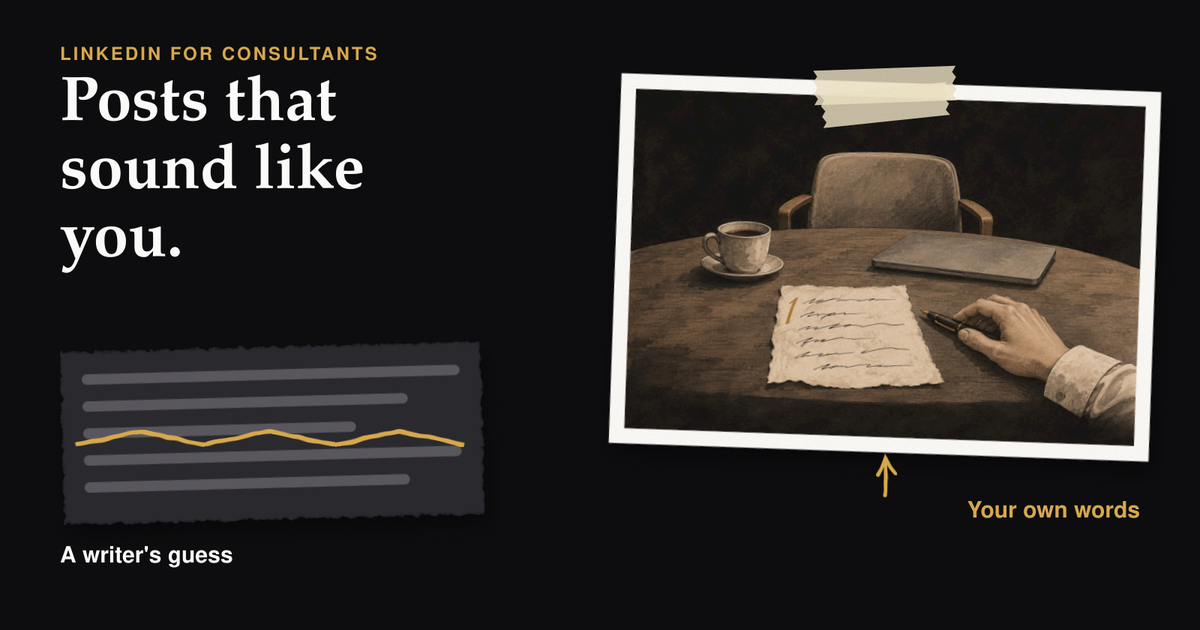
A LinkedIn ghostwriter for consultants is someone who drafts the posts you publish under your own name, so you stay visible to buyers without writing every word. It helps when the writer gets your real judgment, such as how you handled a client problem last week. It does little when they get a topic list, because the posts then say what every consultant says. Inkly works another way: you talk in short interviews, our team shapes your words into posts, and you approve every one.
In this article: how the common ghostwriting arrangement runs, why posts drift toward peers instead of buyers, LinkedIn's account rules, and the questions to ask any provider before you hire.
What does a LinkedIn ghostwriter for consultants do?
The usual arrangement is simple. You fill in an onboarding form, share a few older posts, and agree on themes. The writer drafts a batch each week or month, you read them, and they go out. If you have not met the term before, read a plain guide to LinkedIn ghostwriting.
For a consultant the appeal is clear. Your calendar belongs to clients first, and posting comes last. Writing for LinkedIn gets pushed to "next month," and the gap between expertise and visibility grows. Founders describe the same squeeze in LinkedIn content for founders.
The risk sits in the input. A writer who has never watched you work has to guess at your views. A guess may be reasonable, but it is rarely yours.
Why do ghostwritten posts bring the wrong audience?
A complaint we hear from some experts is that their posts attract other people in the same trade rather than buyers. The likes come from peers, and few of the comments come from a client. Part of the cause is the polished sameness behind why LinkedIn feels fake to many readers.
Three habits cause this:
- Posts speak to peers. Consultants like to write about frameworks. Your peers click like. Your client wants to hear about the problem keeping them awake this quarter.
- The examples are borrowed. A famous quote or a textbook case shows nothing about you. A specific situation, described without naming the client, shows how you think.
- The voice flattens. The way you phrase things is distinctive. A writer who has not heard you talk falls back on their own style or the platform's. There are practical ways to write LinkedIn posts that sound like you.
A post that names one real situation, one decision, and one detail a client would recognise has a better chance of starting a client conversation than a polished general tip. No post can promise one; it simply gives a buyer something to react to.
What are LinkedIn's rules on hiring someone to write your posts?
Getting help with writing is common. Two rules from LinkedIn's own documents still shape how you set it up.
First, accounts are personal. LinkedIn's User Agreement says you will not share your account with anyone else, and it lists "sharing log-in credentials" among the things members must not do. So a writer should never hold your password. The workable setup is that drafts reach you, and you post them yourself.
Second, the content has to be yours in a real sense. LinkedIn's community policies for professionals ask members to use their true identity and only share information that is real and authentic. A post built from your own words and cases meets that standard easily. A post built from invented anecdotes does not.
Client confidentiality matters even more for consultants than for most experts. Agree in advance that no client name, number or detail goes into a draft unless the client has said yes.
How is interview-led content different from ghostwriting?
The difference is where the ideas come from.
With interview-led content, nothing starts with the writer. It starts with you talking. At Inkly, an interview runs 20 to 25 minutes, and the questions cover a call you made on a project, an error clients keep repeating, a question you field weekly. You answer as you would to a colleague.
From that conversation, our team builds posts and longer LinkedIn pieces that keep the way you phrase things. You read each draft and approve it, change it or drop it. Nothing is posted without your yes. People do the interviewing, writing and editing. AI tools only assist with research and grammar, and the judgment stays with you.
We do not call this ghostwriting. The ideas and the approval never leave you, so you remain the author of what you post.
How do I choose a writer, or an interview-led service?
Ask these questions of any provider, including us.
- Where do the ideas come from? An intake form with themes, or your own spoken answers?
- How much of my time does it take? Count the interviews and the review time honestly.
- Who approves each post? If posts can go out without your sign-off, your name carries the risk.
- How is client confidentiality handled? Ask what happens to a story that is too close to a real client.
- Will you ever need my login? The answer should be no.
- Does this lead anywhere bigger? Posts are short. If you have a method worth a book, ask whether those interviews could also feed long-form work.
If you want a steady stream of light posts and you are happy for someone else to choose the angles, a classic ghostwriter can fit. If you want posts that read like your best conversation with a client, begin with your own voice.
For how experts keep their voice in posts, read LinkedIn ghostwriting for experts.
Can the same interviews feed a book?
Often they can. The cases and methods you describe for posts are frequently the backbone of an authority book, and a book can then give your posts something to point to. Our guide to using a book to start client conversations covers that, with no promised results.
Books are built the same way: short interviews, our team writes and edits the chapters, and you approve each chapter yourself.
What is the next step?
Before you hire a LinkedIn ghostwriter for consultants, make sure your profile is ready for the buyers your posts will send to it. Ask for a free LinkedIn profile review: we send written notes covering three parts of the page (headline, About text, featured section), usually a few days after you ask. More guides sit on the blog.
Common questions
- Should a consultant hire a LinkedIn ghostwriter?
- It can work if the writer gets your real thinking, not just a topic list. If you only hand over a form, the posts tend to sound like everyone else in your field, and that does little to win client conversations.
- Can a ghostwriter log in to my LinkedIn account?
- LinkedIn's User Agreement says you will not share your account with anyone else, and it bars sharing log-in credentials. A safe setup has the writer send drafts to you, and you post them yourself.
- Is Inkly a LinkedIn ghostwriter?
- No. Inkly runs short interviews of 20 to 25 minutes, our team turns what you said into posts and longer pieces that keep your phrasing, and you approve every piece before it is posted.
- How do I keep posts sounding like me?
- Build them from your own spoken answers and real client situations, with details removed that could identify anyone, and approve each draft yourself. Posts built from a brief and guesses are the ones that read as generic.
Related articles
- LinkedIn ghostwriting for experts: what it is and how to keep your voice
LinkedIn ghostwriting for experts explained: what the writer does, why ghostwritten posts feel fake, what drives the cost, and how interviews keep your voice.
- Book as Lead Magnet for Consultants: Turn Readers Into Client Conversations
A book as lead magnet for consultants works when readers get a next step: a bonus they sign up for, a workshop on your method, and one clear way to reach you.
- What is LinkedIn ghostwriting? How it works, what it asks of you, and when it helps
What is LinkedIn ghostwriting? A writer drafts posts you publish as yourself. See the steps, LinkedIn's account rules, your time, and who should skip it.
- Why does LinkedIn feel fake? Five patterns readers spot, and how to post like yourself
Why does LinkedIn feel fake? Five post patterns that read as hollow, what AI-detector data says about the feed, and how to write posts that sound like you.