LinkedIn ghostwriting for founders: what to hand over and what to keep
LinkedIn ghostwriting for founders: what a writer can take over, what must stay yours, the account rules to follow, and how a short recorded interview fits in.
By Abdullah Mansoor · · Updated
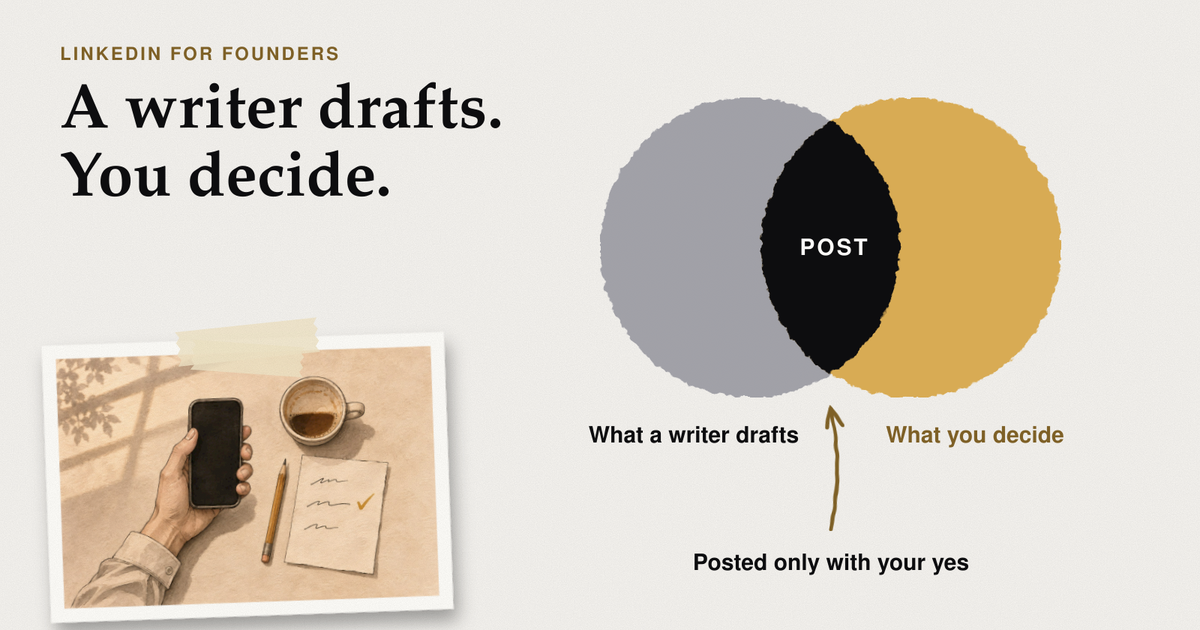
LinkedIn ghostwriting for founders works when the writer does the typing and you keep the thinking. You can hand over drafting, editing and the posting calendar. You cannot hand over your opinions, your numbers or the final yes. When a writer gets only a theme list and a company deck, the posts sound like every other company in your category. When the writer gets 20 to 25 minutes of your actual answers, the posts have your examples and your wording to work from. For the basics of the term, read our explainer on what LinkedIn ghostwriting is.
In this article:
- which parts of founder posting to hand over, and which to keep
- LinkedIn's account rules and how long posting takes to pay off
- what drives the cost, and who should skip it
In LinkedIn ghostwriting for founders, which parts can someone else take?
Split the job before you hire anyone. This is the split we would use.
Hand over:
- first drafts and rewrites
- hooks, structure and formatting
- the posting calendar
- turning one conversation into several posts
Keep:
- your view on your market, including what you disagree with
- every number: revenue, users, hiring, runway
- any story that touches a customer, an investor or an employee
- the yes before anything goes out under your name
The second list holds the things a reader can check, and the things that cost you if they are wrong.
Who is a founder writing for on LinkedIn?
A founder is read by customers, candidates, investors and peers, often in the same week. That is the trap. A post that tries to speak to all four says little to any of them.
Pick one reader per post and name them to your writer. A post for a future customer starts from a problem that customer has today. A post for a candidate starts from how decisions get made on your team. A post for investors is the one to be most careful with, since anything about fundraising or traction is yours to state and nobody else's.
Why do founders' ghostwritten posts feel fake?
A post that reads like a polished general lesson gives a reader no reason to think of you. We look at the wider pattern in why LinkedIn feels fake. A few habits cause that:
- The writer has never heard you argue. Your best lines come out when someone asks you why a customer left. A form cannot ask that follow-up.
- The stories are borrowed. A famous founder's lesson says nothing about your company. One real decision from this month does.
- The numbers are rounded into mush. If a post says "we grew fast", a reader learns nothing. If you tell the writer a figure you are happy to publish, the writer can use it.
Posts built from your own answers have your specifics to draw on, which a theme list does not give a writer. For ways to test a draft against your own voice, see LinkedIn posts that sound like you.
Three illustrations from one interview
Here is an illustration, not a client. On Tuesday a founder of a small software company has a customer call run long. The customer assumed one feature worked a certain way, and it did not. On Thursday the founder sits for a 20 to 25 minute interview and is asked what a customer got wrong about the product this week. The answer is two minutes of plain speech, and it makes one post that a buyer in the same position might recognise. The founder reads the draft, changes one line and says yes. A theme list would not have produced that post.
A second illustration, also not a client. A founder who is hiring says in the same interview that the last two candidates asked how the team decides what to build next. The founder had never written that down. The draft opens with the answer, and a developer reading it can see how this team argues before applying. The founder keeps one sentence out because it names a colleague.
A third illustration, not a client. A founder says "we grew fast" in the interview. The interviewer asks which number the founder would be glad to see in print. The founder names how many customers were added since January and keeps revenue out of it. The draft uses the count and nothing else.
What are LinkedIn's rules when someone else helps you post?
Three parts of LinkedIn's own rules decide the setup.
Your profile is yours alone. LinkedIn's User Agreement tells members not to share their account with anyone, and it names sharing log-in credentials as something members must not do. That rules out giving a writer your password. Drafts come to you, and you press post. The same agreement bars using bots to comment on, like or share posts, so avoid any service that offers to do that from your account.
Your company Page is different. LinkedIn's help page on Page admin roles lists a content admin role to "create and manage Page content". A colleague can run the Page through that role, with no shared login.
Engagement tricks are on the wrong side of the policies. LinkedIn's Professional Community Policies want your real identity on the account and posts that stay "real and authentic". They also say "Don't do things to artificially increase engagement with your content", and they say not to agree with others ahead of time to like or re-share each other's content. A founder who joins a group that swaps likes is taking that risk.
How long does it take before posting pays off?
Slower than most founders expect. The B2B Institute, LinkedIn's research arm, finds in its research on the 95-5 rule that 95% of the people who might buy from you are "out-market" today and will be in-market later. In its joint research with the Ehrenberg-Bass Institute, 75% of companies buy computers once every 4 years and four in five change their banking services every 5 years.
For a founder this has a plain meaning. A post's first job is to be remembered by the people who will need you later. A reply from a customer next week is possible. It is not something anyone can promise, and a writer who promises it is selling something other than posts.
If you need customers next month, posting alone is the wrong tool. Calling the people you already know is a better fit for that goal. Founders who want a slower, deeper asset sometimes look at a book as a lead magnet instead.
What does founder ghostwriting cost, and what does it ask of your week?
Price is set by scope, so ask what is in it. The main drivers:
- how many posts a month, and whether longer articles are part of the package;
- whether the writer works from a form or from recorded interviews;
- how many people write for the account: you alone, or you and a co-founder;
- who presses publish.
Inkly discusses scope and price for this service on a call.
Your time depends on the same split. A form takes as long as you spend filling it, and the draft still has to be rewritten into your voice. With Inkly, an interview is recorded and runs 20 to 25 minutes. After it, the expert approves every piece before it is posted.
Who is this not for?
Skip it, or do something else first, if any of these fit:
- You have not decided what the company stands for. A writer can shape views you hold. Views you have not formed yet cannot be written for you.
- You want leads this quarter. See the section on time above.
- You will not read the drafts. Your name goes on every post, and you carry the risk.
- You enjoy writing and already post each week. An editor may be enough.
- You run a clinic, not a company. Our notes on LinkedIn content for doctors fit you better.
- You want someone to comment as you. That is the one thing no good service should do for you.
What does the interview route look like for a founder?
Inkly turns short interviews with an expert into LinkedIn posts and long-form articles in their voice; the expert approves every piece before it is posted. AI tools help with research and grammar; people do the interviews, writing, editing and judgment. Inkly is not a ghostwriter: the ideas come from you, and so does the approval.
Our notes for consultants, the wider guide to LinkedIn ghostwriting for experts and our checklist for software that several people post from cover related questions, such as several people posting on one account.
What can you fix on your page before anyone writes for it?
A candidate or a customer who likes one of your posts will open your profile before they reply. Three quick checks on what they find:
- Read your headline. Does it say what you do for whom, in the words a customer would use?
- Read your About section. Is there a real decision or a number in it, or only adjectives?
- Read your featured section. Could a candidate or a buyer open one item there and learn how you think?
Every post you publish sends a reader to that page, so it is the part of founder posting you can fix this week. Inkly will do that look for free. Send us your LinkedIn profile link for a free LinkedIn profile review and, within a few days, we send back notes on your headline, About wording and featured posts, read the way a buyer who clicks through from a post would read them. Whoever drafts your posts, LinkedIn ghostwriting for founders only pays off when that page holds up.
Common questions
- Is LinkedIn ghostwriting worth it for a founder?
- It can be, if the writer hears your real views and you read every draft. If the writer only gets a theme list and your pitch deck, the posts say what every company in your category says, and they are easy to forget.
- Can someone post from my founder account for me?
- Do not hand over your login. LinkedIn's User Agreement says you will not share your account with anyone else. Drafts should come to you and you post them, or you give a colleague a role on your company Page instead.
- What decides the cost of LinkedIn ghostwriting for a founder?
- The drivers are how many posts you want each month, whether long-form articles are included, and whether the writer works from a form or from recorded interviews. Inkly discusses scope and price for this service on a call.
- Is Inkly a LinkedIn ghostwriter for founders?
- Inkly is not a ghostwriter. It turns short interviews with an expert into LinkedIn posts and long-form articles in their voice; the expert approves every piece before it is posted. The ideas and the final yes stay with you.
- How long before LinkedIn posting brings customers or hires?
- There is no reliable date. LinkedIn's B2B Institute reports that 95% of potential buyers are not ready to buy today, so most readers meet you long before they need you. Judge it over months, not weeks.
Related articles
- LinkedIn ghostwriting for experts: what it is and how to keep your voice
LinkedIn ghostwriting for experts explained: what the writer does, why ghostwritten posts feel fake, what drives the cost, and how interviews keep your voice.
- LinkedIn ghostwriter for consultants: what to check before you hire one
Thinking of a LinkedIn ghostwriter for consultants? See what they do, where posts go generic, the account rules, and how interview-led content differs.
- LinkedIn content tool for teams: what to check before you pick one
Picking a LinkedIn content tool for teams? Check voice, approval, roles, employee advocacy and scheduling, and see when short expert interviews do more.
- What is LinkedIn ghostwriting? How it works, what it asks of you, and when it helps
What is LinkedIn ghostwriting? A writer drafts posts you publish as yourself. See the steps, LinkedIn's account rules, your time, and who should skip it.