What is LinkedIn ghostwriting? How it works, what it asks of you, and when it helps
What is LinkedIn ghostwriting? A writer drafts posts you publish as yourself. See the steps, LinkedIn's account rules, your time, and who should skip it.
By Abdullah Mansoor · · Updated
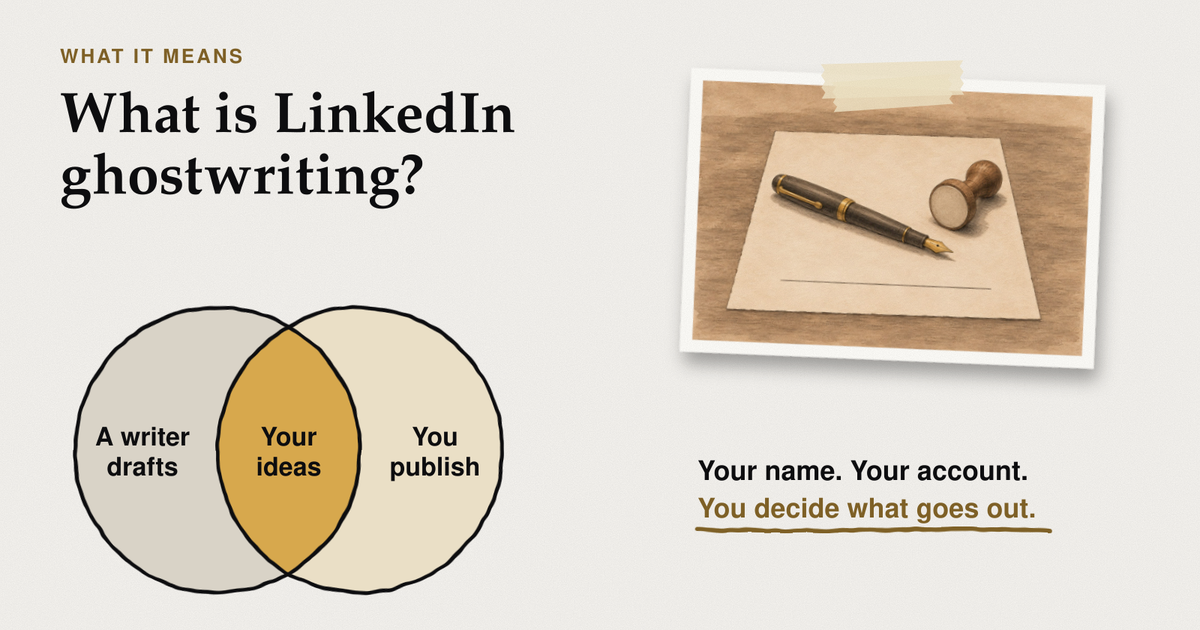
What is LinkedIn ghostwriting? A writer does the drafting and you do the publishing, from your own account and under your own name. Merriam-Webster defines a ghostwriter as "one that writes for and in the name of another." It saves you the typing, and it only works when the writer starts from your real thinking, not from a list of topics. The part nobody can hand over is the approval: you decide what goes out.
In this article: - how the work runs, week by week, and what LinkedIn's rules mean for it - what it asks of you, how long it takes to pay off, and when to skip it
What is LinkedIn ghostwriting in practice, step by step?
The shape is similar across providers, even when the names for each step differ.
- Intake. You answer questions about your work, your buyers and your views, often in a form, and share a few older posts.
- Drafting. The writer produces posts, usually in a batch.
- Review. You read each draft and change it, approve it or drop it.
- Posting. The post goes out under your name, from your account.
Steps one and three decide whether the posts sound like you or like the rest of your field. If your worry is posts that all sound alike, or read like generic AI output, ask any provider who does the interviewing and who does the writing before you sign. We list the warning signs in keeping posts in your own voice.
What does a week look like with a writer?
Here is a labeled illustration, not a client. A structural engineer receives her first batch of drafts on a Tuesday. Post two opens with a site visit that never happened; the writer had filled a gap in the notes with a plausible scene. She reads every draft, so she catches it, strikes the story and sends back a real one from that week: a client asking why an inspection slipped. The batch goes out two days later with one post fewer than planned.
A month on, the gap is gone. Each Friday she sends the writer three lines on what happened on site: a delay, a client question, a decision she made. The drafts start to use them. By the third Friday a batch opens with her own sentence about the delayed inspection, and she changes only a verb before approving.
Both weeks are LinkedIn ghostwriting by the plain definition: the writer drafts, she publishes. The first week was safe because she read the draft. The second was better because the ideas were hers.
Is LinkedIn ghostwriting allowed?
Neither of the two LinkedIn legal pages we read, the User Agreement and the Professional Community Policies, mentions ghostwriters by name. What they say still shapes how you set it up: publish from your own account, and keep the content true to you.
A LinkedIn account belongs to one person. LinkedIn's User Agreement bars members from sharing an account, and cites "sharing log-in credentials" as one case of using another person's account. No writer should ever hold your password. Safer: the writer emails drafts, and you press publish yourself.
The words also have to be truly yours. On honesty, the Professional Community Policies ask members to share what is "real and authentic." Posts built from your own cases fit that wording. An invented anecdote does not, and readers notice; why LinkedIn feels fake looks at what that costs.
The same page warns against artificial engagement, including pre-arranged swaps of likes and shares between members. Any provider offering a ring of other accounts to boost your posts is selling that. Walk away.
What does LinkedIn ghostwriting ask of you?
It asks for three things, and none is typing.
- Material. Real stories, real numbers, real opinions. If you cannot say what you think about your own field in ten minutes, the posts will be vague.
- Review time. Reading every draft is the safety step. Ask each provider how many minutes a batch takes you to read, and how many rounds of revision you get.
- Judgment about confidentiality. A post that makes a client easy to identify is your problem, not the writer's. Take a draft about a regional logistics client that just opened a third office (an illustration, not a client): anyone at that client will recognize it. Agree beforehand that no client detail goes into a draft without that client's yes.
The money side varies with how many pieces you want, how the writer gets your ideas (a questionnaire or interviews), and how many rounds of revision you get. Prices are not discussed here; ask each provider what is in scope before you compare totals. Founders weighing the same trade can read LinkedIn content for founders, and teams posting from several accounts can see how teams share one posting tool.
How long before it pays off?
Slower than most people hope. LinkedIn's B2B Institute, writing about buyers and advertising, sums up its 95-5 research this way: "95% of your potential buyers aren't ready to buy today." Those buyers will be "in-market" later, and posts that keep your name in front of them are the part that applies to you.
Judge a month of posts by one thing: will a buyer who needs you next year already know your work? A buyer writing to you next week can happen, but no provider can promise it, and a quote that treats it as a deliverable is a warning.
How does Inkly get your ideas without a blank page?
At Inkly, the ideas begin with you talking. Inkly turns short interviews with an expert into LinkedIn posts and long-form articles in their voice; the expert approves every piece before it is posted. The interviews are recorded and last 20 to 25 minutes. AI tools help with research and grammar; people do the interviews, writing, editing and judgment, and the author approves every chapter.
For you, that means the first step is a short recorded interview, not a blank page, so your time goes on judgment rather than typing. A questionnaire is the other common way to do it. Pick by asking where you want the ideas to come from. For the expert's side of this, see LinkedIn ghostwriting for experts and the notes for consultants.
When is hiring a LinkedIn writer the wrong move?
- You need clients this month. A call to a former client is faster.
- You will not read drafts. Without your review, you are paying for risk under your own name.
- Writing is a pleasure and you post weekly. An editor on call may be enough.
- You have not decided what you stand for. A writer can polish opinions you hold, but cannot invent ones you lack.
Where does your name on a post lead?
A ghostwriter writes in the name of another, and a name on a post is a link. A reader who likes one post taps it and lands on your profile, whoever drafted the post. That page decides whether the reader stays, so it is worth a second pair of eyes before you hire anyone. More on the topic sits on the Inkly blog.
Inkly will give your profile that second read for free. Mail your profile URL to hello@inklyai.io and a written reply follows within a few days, with suggestions on your headline, your About section and your featured section. Hire a writer or not, the LinkedIn ghostwriting choice is separate: the review covers what a visitor sees there, and it makes no promise about reach, followers or leads: ask for a free LinkedIn profile review.
Common questions
- What is LinkedIn ghostwriting in simple terms?
- A writer drafts posts for you, and you publish them from your own account under your own name. The ideas should be yours, and the final approval is yours too.
- Is LinkedIn ghostwriting allowed?
- LinkedIn's User Agreement says members must not share their account, so the writer sends drafts and you post them. The Professional Community Policies ask members to share information that is real and authentic, so the content must be true to you.
- How to prepare for working with a LinkedIn ghostwriter?
- Your real thinking: how you handled a recent problem, what you would tell a client, where you disagree with your field. A topic list alone gives the writer nothing of yours to work with.
- How much does LinkedIn ghostwriting cost?
- It depends on how many pieces you want, whether ideas come from a questionnaire or interviews, and how many revision rounds you get. Ask each provider what is in scope before you compare totals.
- How is Inkly different from a LinkedIn ghostwriter?
- Inkly turns short interviews with an expert into LinkedIn posts and long-form articles in their voice; the expert approves every piece before it is posted.
Related articles
- LinkedIn ghostwriting for experts: what it is and how to keep your voice
LinkedIn ghostwriting for experts explained: what the writer does, why ghostwritten posts feel fake, what drives the cost, and how interviews keep your voice.
- LinkedIn ghostwriter for consultants: what to check before you hire one
Thinking of a LinkedIn ghostwriter for consultants? See what they do, where posts go generic, the account rules, and how interview-led content differs.
- Why does LinkedIn feel fake? Five patterns readers spot, and how to post like yourself
Why does LinkedIn feel fake? Five post patterns that read as hollow, what AI-detector data says about the feed, and how to write posts that sound like you.
- LinkedIn posts that don't sound like AI: six tells to cut and how to keep your own voice
LinkedIn posts that don't sound like AI: six tells readers notice, why detectors and readers both get it wrong, and a short method to keep your own voice.