Can Anyone Be a Thought Leader? What It Takes, and Who Gets There
Can anyone be a thought leader? Anyone with real expertise can start, but the title is given by others. See what buyers reward and why most never earn it.
By Abdullah Mansoor ·
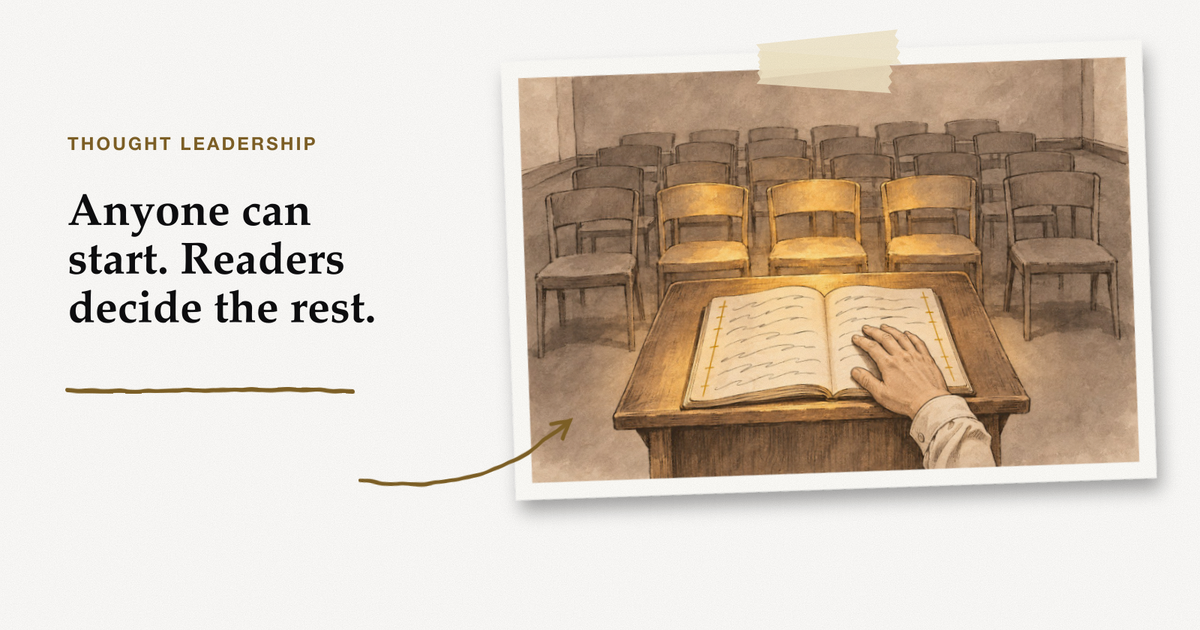
Can anyone be a thought leader? Anyone with real expertise and a clear point of view can start doing the work, and no title, degree or permission is needed for that. But the label itself is given by other people. You earn it when the same readers keep finding your thinking useful, and most people who start never stay long enough to get there.
In this article: what the phrase actually means, why the title cannot be claimed, what buyers say they reward, a worked example, and who should not bother.
Can anyone be a thought leader, or is it a title for the famous?
Start with the definition. Wikipedia's entry on thought leaders describes one as "an individual or firm recognized as a foremost authority in a specific field."
The key word is recognized: expertise is something you have, while recognition is something other people give you. That splits the question in two.
Can anyone do the work? Yes. A tax adviser who explains one confusing rule better than anyone in her city is doing it. So is a surgeon who writes the clearest guide to recovery after one operation.
Can anyone be called one? Only if enough of the right people say so. Fame is not required. A plant engineer known by four hundred procurement heads is a thought leader to those four hundred people, and that may be the only audience that matters to his business.
Why does the phrase make people cringe?
Because it is so often self-applied. The same Wikipedia entry notes that critics call the phrase "meaningless management speak," and quotes Harvard Business Review contributor Dorie Clark, who defends the idea while agreeing "that it is very icky when people call themselves thought leaders."
That is the first practical rule: never put the phrase in your own bio. Say what you fix and for whom. If you have ever wondered why LinkedIn feels fake, a feed full of self-crowned leaders is a large part of it.
The second rule follows from the first. Thinking that leads has to say something. A post that repeats what everyone in your field already believes is content, not leadership; readers remember a position they could disagree with.
What do buyers actually reward?
The best public numbers come from a 2024 buyer survey by Edelman with LinkedIn, summarised on Edelman's insight page (archived August 2026).
73% of B2B buyers in that survey consider thought leadership "a more trustworthy basis for judging a company's competencies than traditional marketing materials."
Only 15% say the quality of what they read is very good or excellent.
62% say content of average or better quality is produced by "prominent, well-known experts."
Read those three together and the answer to the question gets sharper. Buyers want this kind of thinking and trust it more than ads. Most of what they get is not good. And they link good work to people who are already known, which is why recognition and quality grow together, slowly.
What separates the 15% from the rest?
The same report says 66% of buyers link better content to "a unique format or style that looks different than other content they typically see." In plain terms: a real point of view, said in a way only you would say it, backed by work the reader can check. A voice of your own matters more here than polish, which is the whole argument for posts that sound like you.
How do you start when nobody knows you yet?
You do not need an audience to begin. You need a narrow subject and a habit.
- Pick one question. Choose the question clients ask you most often and that you answer better than most. Keep it narrow enough that you could be the clearest voice on it.
- Take a position. Write down what you believe about it that many of your peers do not. If nobody could disagree, keep digging.
- Answer it in public, weekly. Short posts are fine. If time is the problem, LinkedIn ghostwriting for experts can turn recorded conversations into posts you approve.
- Collect the reactions. Note which answers get questions back. Those questions are your next posts, and later your chapters.
- Gather the answers into one body of work. After a year of answers, you usually have the bones of a book, a talk or both.
Step five is where many experts stall. Posts scatter an argument across hundreds of small pieces; a reader who meets you in week forty sees one fragment. A book holds the full argument in one place someone can read, quote and pass on, which is why it so often anchors an author's personal brand.
A worked example: one consultant, two years
Treat this as an invented case built for teaching. A supply-chain consultant notices that every new client asks the same thing: why their warehouse counts never match the system.
In the first year she posts one answer a week, each from a real job with the names removed. Most posts get a handful of comments. Around month seven, two procurement heads start forwarding her posts to their teams. One asks if she runs workshops.
In the second year she turns the forty most useful posts into the outline of a short book on stock accuracy. Nobody calls her a thought leader yet. But when a conference needs a speaker on inventory, her name is the one three people mention. The book did not create that. It gave the people already listening something to hand to the next person, and it turns speaking invitations into a matter of follow-up rather than cold pitching.
What does it cost you, and is it worth it?
What you pay is mostly hours and exposure.
- Time: a weekly hour, for a year or more, before anything you could call recognition.
- Exposure: a clear position invites disagreement in public. Some peers will think you are wrong, and some will say so.
- Time to result: slow. Edelman's own figures show only 29% of companies "can link sales leads or business wins back to specific thought leadership efforts," so even firms that invest heavily struggle to see a straight line.
It is worth it when your work is sold on trust, when buyers choose you over a cheaper option because they believe your judgment. That is true for most consultants, doctors, lawyers and specialist founders. A book can then bring client conversations by handing a prospect your thinking before the first call.
Who should not chase thought leadership?
- People with nothing new to say yet. If your view matches your field's textbook, spend another year doing the work first.
- People who want quick leads. Ads and referrals are faster. This is a slow asset.
- People whose clients never search for ideas. If you win work purely on price or location, depth of thinking will not move buyers much.
- People who will not keep going. Ten posts followed by silence tell readers you stopped, which is worse than never starting.
Where does your thinking go from here?
The honest answer to the search is that the door is open to anyone, and the title is decided by your readers. The people who get there pick one question, take a position, keep answering in public, and then put the whole method somewhere readers can hold it.
For many experts that somewhere is a book. With Inkly, the book is built from recorded interviews of 20 to 25 minutes, and nothing goes ahead until you have approved each chapter. One example of where that can lead: Mr Junaid, the educational visionary behind Raising the 2040 Child, has sold 1,600+ copies, and his workshop tour has held events in Dubai, Riyadh, Medinah and Jeddah.
If you have a year of answers in you, request a free draft table of contents and see them as chapters; it is a short form written with doctors in mind, and a consultant, lawyer or engineer is just as welcome to use it. Tell us your field and the topic you'd teach. Our editors prepare a free draft table of contents for your book and email it to you within a few days. You keep it whether or not we ever work together.
So, can anyone be a thought leader? Anyone can start tomorrow; the readers decide when you have arrived.
Common questions
- How to become a thought leader with no following?
- Start with one narrow question your clients keep asking and answer it in public, in writing, every week. A following comes after a body of useful answers, not before it.
- Do you need a book to be a thought leader?
- No. Plenty of respected experts have none. A book helps when your ideas need more room than a post allows, because it puts your whole method in one place that others can read, quote and hand on.
- When to hire help to become a thought leader?
- When you already have the ideas and the weekly answers, but not the hours to write them up. Help with posts or a book saves writing time; it cannot speed up recognition, which builds over years as the same readers keep finding your thinking useful.
- Is it cringe to call yourself a thought leader?
- Usually, yes. Even writers who defend the phrase say it sounds self-important when you apply it to yourself. Let other people use the word; you describe the problem you solve.
Related articles
- Personal Brand for Authors: Meaning, Examples and a Weekly Plan
What a personal brand for authors actually is, three real examples, who it does not suit, and a one-hour weekly plan built from your own book chapters.
- How to Get Speaking Gigs With a Book: A Plan for Nonfiction Experts
How to get speaking gigs with a book: turn chapters into three talk titles, list the rooms your readers sit in, and offer organisers copies instead of a fee.
- Book as Lead Magnet for Consultants: Turn Readers Into Client Conversations
A book as lead magnet for consultants works when readers get a next step: a bonus they sign up for, a workshop on your method, and one clear way to reach you.
- How a Book Builds Authority for Consultants, and Where It Stops
How a book builds authority for consultants: it gives prospects a full sample of your thinking before the first call. See the survey figures and the limits.